Wednesday, July 29, 2015

Cbus Libraries

Cbus Libraries

Starting early last year, I began a library project called Cbus Libraries with my colleague, Andrea Dixon.  We wanted to highlight the amazing work being done by library professionals and the wide breadth of libraries in Central Ohio.

What we've seen is incredible.  From presidential archives to plush zebras, we've touched hand written letters from President George Washington, rummaged through non-traditional seed catalogs, took in the beauty of artists' books, leafed through a first edition of Uncle Tom's Cabin, ambled along rows of tools that are used to create better communities, and so much more. 

Behind every library we visited, we met with enthusiastic professionals that take great pride in their work, libraries, and communities.  What an inspiration!

Thus, I have posted less here and focused more on Cbus Libraries.  Andrea and I presented on special libraries last November at Columbus Pecha Kucha Night.  After more visits and discussions, we'd like to present again in 2016.  I imagine I'll use this blog as a sounding board as we look to shape our story about the fantastic, and sometimes rarely known, resources we have here in Central Ohio.

Monday, November 17, 2014

Cbus Libraries and Pecha Kucha Columbus


Last Thursday I had the honor to present with my amazing colleague Andrea Dixon on special libraries in Central Ohio.  Our goal was to share the value these libraries provide and the incredible work of their professionals.  We were thrilled to formally launch Cbus Libraries.

We had a wonderful experience at Pecha Kucha Night (PKN) Columbus.   PKN is described as "the art of concise presentations."  If you aren't familiar with it, PKN is a national movement of local events where presenters have 20 slides and 20 seconds for each slide.

Check out our presentation below.  For the notes on each slide, click on the link below the slideshow and click on the Notes tab.


Monday, April 08, 2013

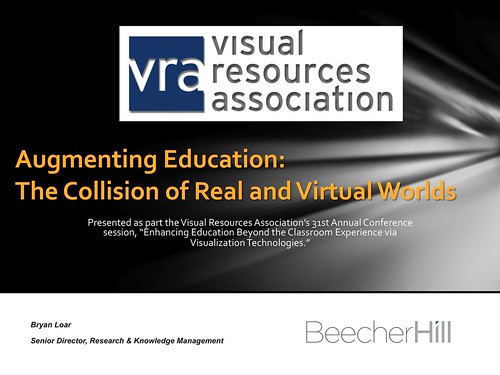
Augmenting Education Presentation at VRA 2013

Image: Slide 1, Augmenting Education: The Collision of Real and Virtual Worlds. 
This presentation explores augmented reality and potential uses within arts education. The presentation has been enhanced from the previous October 2012 presentation. Videos have been added, new examples have been provided, further explanations have been added to the notes, and the information has been tailored to the Visual Resources Association audience.

Presented as part the Visual Resources Association’s 31st Annual Conference session, “Enhancing Education Beyond the Classroom Experience via Visualization Technologies.”

The PowerPoint presentation with embedded videos can also be downloaded as a zipped file at http://bit.ly/AR_pptx_vra2013  [Note: Viewing the presentation with embedded videos has been known to be problematic.  Depending on your version of PowerPoint and your operating system, the videos may or may not play.]


Thursday, February 21, 2013

Dieter Roth

Image: Wait, Later This Will Be Nothing Book Cover, ©MoMA. 


An interesting new book titled Wait, Later This Will Be Nothing by Sarah Suzuki comes out this month from the Museum of Modern Art (MoMA).

As I was preoccupied with everything around WWI in my art studies, I never heard of Dieter Roth before.  I love his Literature Sausage (Literaturwurst) made of ground-up books, and prints made with organic materials instead of inks are pretty smart too.

A nice, 16-page sample PDF preview is also included in MoMA's description.


Monday, January 14, 2013

Aaron Swartz and the Open Access Movement

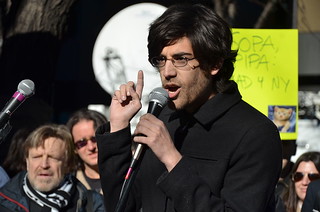
Image: Aaron Swartz by Daniel J. Sieradski via okfn
 "Those with access to these resources — students, librarians, scientists — you have been given a privilege. You get to feed at this banquet of knowledge while the rest of the world is locked out. But you need not — indeed, morally, you cannot — keep this privilege for yourselves." - Aaron Swartz, Guerrilla Open Access Manifesto.

As a means of tribute to Aaron Swartz, his beliefs, and a form of online civil disobedience, more than 1,500 links have been posted on twitter to copyright-protected research.  The links are collected via the #pdftribue hashtag and can be found at the site pdftribute.net.

 
Video:   F2C2012: Aaron Swartz keynote - "How we stopped SOPA" 

Aaron Swartz was heralded as a young genius who co-authored RSS at age 14 and later started a company that would morph into Reddit.

He also was proponent of greater access to information, and he allegedly took that position when downloading over 4 million academic articles from JSTOR with the intent to distribute without permission.

Andrea Peterson at Slate pondered if Aaron's apparent suicide might be a catalyst for mainstreaming open access journal practices.

With over 13,000 researcher signatures boycotting Elsevier, another large academic publisher, momentum is gaining for research to be more widely available--not just to the a minority that have institutions that can afford subscription costs (and even they sometimes can't meet those financial demands).

Open access' value proposition is that the removal of subscription fees and keeping copyrights with the authors will increase access to information. One solution is to have the journal costs paid by the author(s) through research grants. The problem is that publishing in well-respected journals where the likelihood of citation is greater is tied to the researchers' requirements for tenure, and those journals are typically subscription based. So, while previous movements to dismantle the subscription system (including petitions with over 30,000 signatories have occurred), none have created widespread change.

With growing dissent for subscription-based, academic journal distributors and recent ideologies like the Anonymous and Occupy movements, we may see a cultural shift that Aaron called for in his Guerrilla Open Access Manifesto [1].

Notes

[1] Interestingly, and not surprisingly due to looming litigation, the manifesto is no longer on Aaron's site.  Although traces on Google can be found by searching site:aaronsw.com "guerrilla open access"

Monday, October 22, 2012

Augmenting Education: The Collision of Real and Virtual Worlds


This presentation explores augmented reality and potential uses within arts education.  It was presented as part the SECAC 2012 Visual Resources Curator Group session, "When the Past Collides with the Present: Moving Beyond the Single Classroom Experience via Digital Technologies."

Friday, October 19, 2012

BeecherHill


My employer recently announced a name and brand change from SC search consultants to BeecherHill.  The process took about a year, and I was fortunate enough to take part in the process.

BeecherHill as a name pays homage to both Founder Cindy Hilsheimer and to the locations of our business (Beecher Rd. and Beecher Crossing North).  However, as one of our associates put it, the name goes beyond that...it is a representation of climbing towards a goal.  For me, that goal is excellence.  Excellence in our service, our community, and each other. 

I'm very proud to work with such a talented group of professionals, and I'm inspired by the impact we have on exceptional leaders, our clients, and our community.

Tuesday, October 16, 2012

Augmented Reality Resources

Image: Slide from Augmenting Education: The Collision of Real and Virtual Worlds. 
I've compiled a number of nice resources and examples for my upcoming presentation on augmented reality in Diigo.  Check them out at bit.ly/secac12-AR.

(Note: This is a work-in-progress.  Collection is still ongoing and some cleanup of tags & descriptions before the conference need to take place.)

Monday, October 15, 2012

Upcoming SECAC Presentation on Augmented Reality

Image: Slide from Upcoming Presentation on Augmented Reality. 

I am very excited to be part of the upcoming session "When the Past Collides with the Present: Moving Beyond the Single Classroom Experience via Digital Technologies" at the Southeastern College Art Conference (SECAC) 2012.

My presentation focuses on augmented reality (AR) and how AR can enhance the educational experience.  Below is my abstract.

Augmenting Education: The Collision of Real and Virtual Worlds

Augmented reality contextualizes and gives deeper meaning to real-world objects, and it provides educators with a means to extend the classroom beyond traditional confines.  The technology uses mobile devices, head-mounted displays, or eyewear to produce an informational layer between the viewer and the viewed.  Unlike virtual reality, a completely simulated experience, augmented reality overlays virtual information over the real world.  Architecture, sculpture, and the visual arts in situ can be complemented with a rich layer of data.  Consequently, living labs may be constructed that enhance the educational experience and student engagement.  This paper explores current case studies, suggests practical applications, and speculates on the future of education-based augmented reality.

For more information on SECAC, please visit www.secollegeart.org.

Monday, August 27, 2012

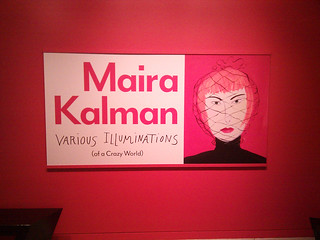
Maira Kalman

Image: "Maira Kalman at the Contemporary Jewish Museum" Courtesy of Susan Magnolia. 
Video: Illustrator Maira Kalman Explores Art and Existence by thinktv. 

Nice video where Kalman gives biographical info as well as some insights into her work.

Friday, August 24, 2012

Robin Hoods L!brary Initiative

Image: New York City Public School 47 Library.  Still of "Maira Kalman's Library Art" Courtesy of the Robin Hood Foundation. 

 Video: Maira Kalman's Library Art by RobinHoodFoundation. 

What an awesome initiative!  They've created some beautiful, inspiring school libraries.

The L!brary Initiative, a partnership of the Robin Hood Foundation and the New York City Department of Education, with support from the Mayor, corporate donors, and a team of architects, seeks to reverse these patterns of low literacy skills and underachievement by working with community school districts and public elementary schools to design, build, equip, and staff new elementary school libraries.


Thursday, August 23, 2012

Christian Moeller Sculpture at Walnut Creek Library

Image: Image of "Shhh" Courtesy of UCLA. 

Video: Walnut Creek Library Art Time Lapse by CityofWalnutCreek.  


I wonder if Moeller or the City of Walnut Creek chose the subject's "shushing" pose.  While I respect Moeller's ability to create visually striking art, I was disappointed to see the final product--an image that reinforces the stereotype of librarians as "bespectacled, bun-sporting ladies who shush patrons."

More about the sculpture can be found at http://gallery.dma.ucla.edu/christianmoeller.com/Shhh

Wednesday, August 22, 2012

Lois Lenski E-Book Promo Video

Image for the Milner Library site at Illinois State University. www.mlb.ilstu.edu/ressubj/speccol/lenski/Welcome.html via Lifeonthecutoff Blog. 
Video: Meet Lois Lenski by Open Road Media

Nice video with biographical details.  [Not mentioned...she's an Ohio State grad! ]  More about the e-books can be found here.

Tuesday, August 21, 2012

Monday, August 20, 2012

Butte Public Library Musical PSA

Video: Butte Public Library Musical PSA version 1 by MontanaMovieFactory. 

All libraries should have chorus lines.

Tuesday, August 14, 2012

OSU Billy Ireland Caroon Library & Museum

 
Video: OSU Billy Ireland Cartoon Library & Museum. 

Nice video talking about the library within the Wexner complex at Ohio State University.  For more information, please visit http://cartoons.osu.edu/

Saturday, August 11, 2012

Pelotonia - Please Help Fight Cancer

 
This weekend over 6,000 riders will ride from Columbus in an effort to raise funds to benefit The Ohio State University Comprehensive Cancer Center- James Cancer Hospital and Solove Research Institute.  I humbly ask you to support my effort to end cancer.
 
My grandmother, two of my grandfathers, and my father all had cancer.  Cancer will continue to deeply affect our families if we do not stop it.  Together we can end cancer, but our financial support is absolutely vital.

I ask that you consider a twelve dollar ($12) donation of which 100% goes directly to cancer research at the James.   
My team's hope is to secure hundreds of nominal pledges to reach our ambitious goal! (Therefore, we won't be upset if you share a gift larger than our request.)

To pledge, please follow this link:
http://bit.ly/pelotonia2012_bryanloar

Cancer knows no strangers: my hope is that Pelotonia knows none, too!  Thank you for your consideration of this request and I'd be grateful for your participation. 

Wednesday, July 11, 2012

Libraries as Refuge

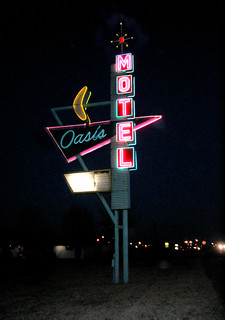
Image: "Oasis Motel retouched neon sign" Courtesy of Lost Tulsa
With the recent wave of storms and power outages in the U.S., libraries have provided a refuge to those looking for cool, indoor relief.  Additionally, they have provided the necessary electricity to re-power mobile devices.  Here are some nice examples of libraries meeting their communities' needs.

Image: "Readers in the children's room" Copyrighted by Arlington Public Library

Arlington Public Library
Arlington Public Library in Virginia partnered with Dominion Power to keep their doors open, the cool air blowing, and the electricity flowing.  Library staff and volunteers generously worked additional hours to serve their community.  To read more, please go here.

Bridgeport Public Library
Bridgeport Public Library in West Virginia, a state with 35,000 still without of electricity, positioned itself as the perfect place to keep cool and discover the back story to movie blockbusters like the Avengers.


Wednesday, June 27, 2012

Geisel Library

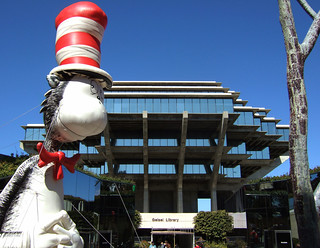
Image: "CatinHat" Courtesy of jtrummer. 

An amazing library located at the University of California-San Diego.  Formerly known as Central Library, the Geisel Library was renamed in 1995 in honor of the generosity of Audrey and Theodor Geisel (Dr. Seuss).

For more info, please go to http://libraries.ucsd.edu/about/geisel-building.html


Monday, June 25, 2012

The USPS as a Warning for Libraries

Image: "Cisco Post Office" Courtesy of Kazz.0. 

The debate over the relevance and viability of the United States Postal Service and how to stop the USPS' massive borrowing to stay afloat is far from over.  In May, the U.S. Senate stopped a House-backed bill to begin closures of primarily rural post offices.  Instead, they opted to reduce the post offices' operating hours and move full-time employees to part-time.  Yet, some lawmakers believe that isn't enough (Bingham, 2012).

Librarians take note.

"I hope that my colleagues understand we are looking at basically a dying part of America's economy." - Sen. John McCain reflecting on the USPS (Welna, 2012)

A. Lee Fritschler, a professor of public policy at George Mason University and former chair of the U.S. Postal Rate Commission, argues the primary role of the USPS has shifted from communication to a medium for broadcasting advertising (Moe, 2012).  The adoption of technologies such as the Internet and telephone have brought about that shift.

Libraries face the same challenges.  Libraries, for the most part, have taken a passive role in the creation of technologies to address people's information needs.  Instead of taking a major role in computer sciences, libraries focused on being a service provider--a mediary reliant on others to create information systems.  The mass adoption of information systems that are also providers (e.g. Google) erode libraries' relevancy.  Publishers who can control pricing tiers to different customers as well as who they sell to (e.g. ebook publishers) threaten libraries' relevancy.

I used to think the debate over the death of libraries had no merit.  People will always have information needs.  Libraries offer platforms for the exchange of information, debates, performance, and community development.  Libraries are beacons for fostering intellectual freedom.  Libraries moved away from being book warehouses whose goal was to instill acceptable social norms and behaviors.  Instead, they've placed greater resources on consultancy models that help information seekers effectively navigate massive amounts of data.  However, as information systems become more sophisticated and are able to provide more relevant results to information seekers' queries, the role of the librarian will be diminished.  As publishers create an atmosphere hostile to library acquisitions, libraries' ability to serve their communities' needs will be diminished.  As budgets strain, services such as hours of operation and community services will diminish.  As libraries increasingly move towards not hiring/replacing professional librarians and hire capable para-professionals and part-time employees, the library profession as a whole will be diminished and library/information science schools will begin to close.

Some arguments for the death of the libraries have indicated that the library will just morph into something that can't currently be foreseen, but, what if, the library dissipates into the ether?  The library no longer exists--the library is everywhere.  I'm thinking about the virtual librarian in Neal Stephenson's "Snow Crash."  The book's librarian is a piece of software visualized in a virtual 3-D environment.  While not able to deduce, the librarian asks qualifying question (much like a reference interview) to "understand" the semantics of its patrons' queries.  The librarian can access sheer amounts of data very quickly.  Now imagine having this librarian at your disposal at any time in any place.

The United States Postal Service is economically unhealthy, currently unsustainable, and did not adequately transition to meet the needs of the public.  Can we say differently about libraries?

***

Further Reading of Possible Interest

Academic Library Autopsy Report, 2050
by Brian T. Sullivan
The Chronicle of Higher Education
http://chronicle.com/article/article-content/125767/ 

Extinction Timeline 2
by what'snext
http://nowandnext.com/PDF/Extinction%20Timeline%202.pdf 
[Note: Interesting the original timeline had all libraries, but the second timeline has just school libraries.]