Showing posts with label copyright. Show all posts

Monday, January 14, 2013

Aaron Swartz and the Open Access Movement

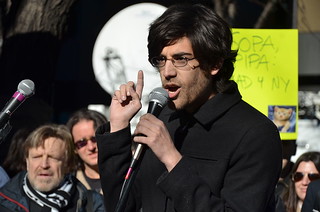
Image: Aaron Swartz by Daniel J. Sieradski via okfn. 
 "Those with access to these resources — students, librarians, scientists — you have been given a privilege. You get to feed at this banquet of knowledge while the rest of the world is locked out. But you need not — indeed, morally, you cannot — keep this privilege for yourselves." - Aaron Swartz, Guerrilla Open Access Manifesto.

As a means of tribute to Aaron Swartz, his beliefs, and a form of online civil disobedience, more than 1,500 links have been posted on twitter to copyright-protected research.  The links are collected via the #pdftribue hashtag and can be found at the site pdftribute.net.

 
Video:   F2C2012: Aaron Swartz keynote - "How we stopped SOPA" 

Aaron Swartz was heralded as a young genius who co-authored RSS at age 14 and later started a company that would morph into Reddit.

He also was proponent of greater access to information, and he allegedly took that position when downloading over 4 million academic articles from JSTOR with the intent to distribute without permission.

Andrea Peterson at Slate pondered if Aaron's apparent suicide might be a catalyst for mainstreaming open access journal practices.

With over 13,000 researcher signatures boycotting Elsevier, another large academic publisher, momentum is gaining for research to be more widely available--not just to the a minority that have institutions that can afford subscription costs (and even they sometimes can't meet those financial demands).

Open access' value proposition is that the removal of subscription fees and keeping copyrights with the authors will increase access to information. One solution is to have the journal costs paid by the author(s) through research grants. The problem is that publishing in well-respected journals where the likelihood of citation is greater is tied to the researchers' requirements for tenure, and those journals are typically subscription based. So, while previous movements to dismantle the subscription system (including petitions with over 30,000 signatories have occurred), none have created widespread change.

With growing dissent for subscription-based, academic journal distributors and recent ideologies like the Anonymous and Occupy movements, we may see a cultural shift that Aaron called for in his Guerrilla Open Access Manifesto [1].

Notes

[1] Interestingly, and not surprisingly due to looming litigation, the manifesto is no longer on Aaron's site.  Although traces on Google can be found by searching site:aaronsw.com "guerrilla open access"

Tuesday, November 10, 2009

News Corp., Google, and Copyrights

Really interesting article over on WSJ's blog about how Rupert Murdoch is considering having his news organizations' content (like the Wall Street Journal) removed from Google's indexing.

The article then goes on:

Mr. Murdoch added that News Corp. believes that the fair-use doctrine, which allows for use of copyrighted materials in limited ways such as search results, “could be challenged in the courts and barred altogether.”

Wowza. This is definitely something to watch. Will we have something akin to the RIAA/DMCA for bloggers who republish parts of works like I just did above?

Monday, March 16, 2009

Copyright and Amateur Photography


Image: "Tough Guys" by smif Some Rights Reserved

In our user-generated content (UGC) world, there is more content than ever available to marketers. Traditional stock photography houses like Corbus and Getty Images are threatened by marketers reaching out to sources like Flickr.

However, marketers and the corporations they belong to must be very careful. Unauthorized use of the image or images and not compensating the creator as well as any individuals ("models") in the images can lead to big legal headaches and possible financial repercussions.

Copyright is still copyright. It does not matter if you source your image from a large clearing house or from the guy on the street. I almost wonder if marketing's use of professional image repositories like Getty has made them not realize what has already been done for them--namely setting up a pricing matrix that covers all fees in various types of uses.

While marketers gain "authenticity" from sites that host amateur photography, they loose the safety net that stock photography houses create. This is fine if they understand the net needs to be constructed and disastrous if they don't.

Earlier this year, the Washington Post posted and article entitled, "Hey, Isn't That...." The article deals directly with the issues that I bring up above, and it's worth a quick glance. (Note: it features James Griffioen, the photographer that I used to illustrate the last post [without authorization--another post on copyright and blogging to come])

Friday, March 13, 2009

Copywrong? Warner's Copyright Mishandling


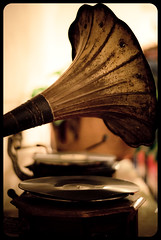
Image: Sounds of Old by C.S. - Now Version [2.0]

Boing Boing and the Twittersphere are all agast at Warner (WMG) trying to protect their assets. Tried quickly find a WMG response on their news page or to see if they even had a Twitter, blog, or some sort of social media pr machine. No such luck. In fact, the 1st hit while searching for "warner music group blog" brings up Wired's 2008 post on WMG pulling music from Last.fm.

Note: TO ALL BRANDS THAT DON'T GET CONSUMERS.

Seriously, I wanted to tell WMG's side, but I don't have the patience. Creating relationships is what business is all about. B2C or B2B...it doesn't matter. The relationship is what will pull you out of the recession [as noted by others] and create lifelong customers (hello!? Lovemarks?!).

Get it? Comcast does.